


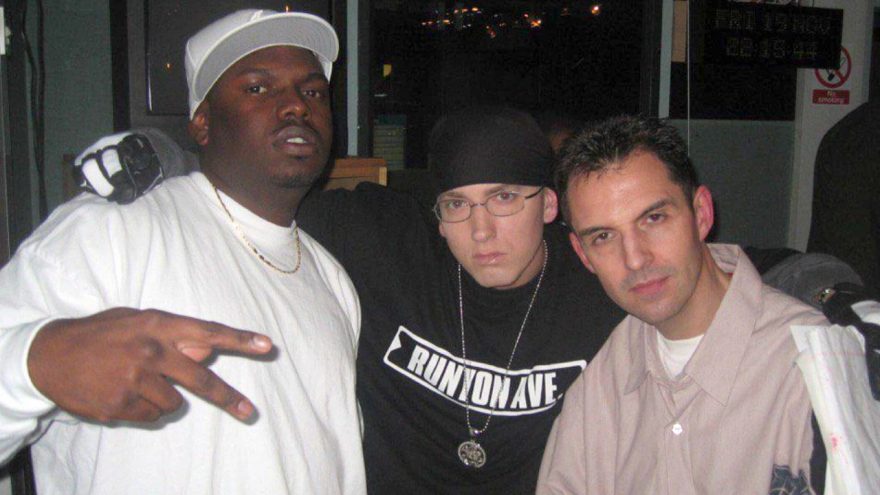
Eminem once believed Stat Quo could be a cornerstone of Shady Records’ next chapter. For a brief moment, that belief placed the Atlanta rapper inside hip hop’s most powerful creative circle. Yet the album never arrived, and years later, Stat Quo has finally explained why.
The Atlanta Native Enters Shady Studios
Stanley Bernard Benton, better known as Stat Quo, did not originally plan a music career. Instead, he studied economics and international business, considering law school before Scarface urged him to rap seriously.
Soon after, his Underground Atlanta Mixtapes reached Los Angeles through industry connections. Eventually, they landed with Mel-Man and then Dr. Dre. One late-night session at Record One Studios produced “The Future”, which later reached Eminem.
As a result, Stat Quo became only the second artist, after 50 Cent, signed jointly to Shady Records and Aftermath Entertainment. The feat that no one could repeat until Ez Mil struck the deal with both Dr and Eminem in 2023. However, his Shady Records debut album, on which he worked for three years, has never been released by the label.
Expectations Inside a Winning Machine
At that time, expectations inside the camp were extreme. Albums moved quickly, radio responded instantly, and platinum plaques felt routine rather than exceptional.
Now, looking back, Stat Quo says the issue was never confidence in his talent. Instead, the concern was scale and risk. “It didn’t make financial sense for them to risk the brand by throwing me out there and not succeeding”, Stat points out to the 3rd Verse podcast hosts.
Moreover, the goal was never a modest result, he adds: “They didn’t want to just let me come out and do platinum”.
How To Ruin Your Deal In One Night
The turning point came during a session with Eminem. Em brought a potential single called “Dance On It”, writing the hook and building the beat himself.
As per his unfortunate habit, Stat Quo responded poorly. “I told Em, ‘Yeah, we could use this as a single. I’ll put it out if you give me a million dollars and rap on it’”.
The reaction was immediate. “Em got so mad, he stormed out of the studio”, Stat recalls.
Dre saw the damage clearly. “I remember Dre was like ‘why would you say that?’ I was like ‘was that wrong?’ He’s like ‘yeah! that’s wrong!’ It was over. Em was like, ‘Fuck it, I’m done. I tried to help you’”.
Years later, Stat Quo admits the mistake without hesitation. “When someone who sold quadrillion albums tells you something should be a single, you should be quiet, and that should be a single. Had that come out, Marshall would’ve championed it. The label would have got behind it because he championed it. It would have been an instant success”.
In fact, Eminem did champion Stat through all his years on the label. Em put his on features (two officials and more, if count leaked tracks), he gave him radio time, included on the label compilations. But sinse that session, the trust has been broken.
When Momentum Disappears
Although Dre initially tried to continue, momentum had already faded. Without external pressure, perfection replaced urgency, which led Stat Quo to make an interesting observation about Dre’s work approach.
“Dre was like, “What are we gonna do to the album now?” And I’m like, “Oh, that shit’s never coming, right?” But Dre was like, “We gonna finish it up. We gonna finish the album up here”. But I knew that wasn’t going to happen.
Just because with Dre, the noise from the outside has to be there. If he ain’t hearing no noise from outside of what’s going on, he just not really fucking with it. He’ll sit there and overthink the project. But when the noise is, like Kendrick’s noise outside of Aftermath and even TDE, what they were doing for Kendrick, it became so loud that you could not ignore it. They had to put the record out. But if it was up to Dre, they would have kept working on that until it was this perfect thing”.
Evidently, with Stat Quo, without that noise, the album slowly disappeared.
The Lesson Learnt
Looking back, Stat Quo names the real cause. Talent alone never guarantees success. What matters is trust, timing, and understanding the room. Most of all, listening to people who already earned their position matters.
Because talent opens the door, but judgment decides whether it stays open.