



YouTube is about to vanish from the Billboard charts. Starting in 2026, millions of streams will stop counting overnight.
When YouTube announced it would stop supplying streaming data to Billboard, the news landed quietly but carried major consequences. Starting January 16, 2026, YouTube streams will no longer count toward Billboard charts, ending a decade-long partnership that shaped how modern hits were measured.
Whose voice counts
At the centre of the dispute is a familiar industry argument: how much a stream is really worth.
Billboard has long weighted paid subscription streams more heavily than ad-supported plays. Until recently, one paid stream counted the same as three free ones. Even after Billboard adjusted the ratio to roughly 2.5-to-1, YouTube says the formula still undervalues how fans actually engage with music today.
According to YouTube’s global head of music, Lyor Cohen, the issue is not technical but philosophical. He argues that every fan interaction should count equally, regardless of whether it comes from a subscription or an ad-supported view. From YouTube’s perspective, free listeners are not second-class fans, and treating them as such distorts the picture of real cultural reach.
With Billboard unwilling to move to a one-to-one ratio, YouTube chose to pull out entirely.
That decision reshapes the charts in a fundamental way. YouTube is not just another platform. It is the world’s largest music discovery engine, especially for genres driven by visuals, virality, and repeat viewing. Removing YouTube from Billboard’s data pool means removing hundreds of millions of listens that reflect how people actually consume music.
The consequences
Hip hop stands to feel this change more than most genres.
Rap artists consistently generate massive YouTube engagement, often far exceeding their audio-only streaming numbers. That includes Eminem, who remains the most watched hip hop artist globally and one of the most viewed American artists on the platform year after year.
Without YouTube counted, Eminem’s chart presence will rely almost entirely on audio streaming and sales. His catalogue is strong enough to survive that shift. He still posts dominant numbers on Spotify and Apple Music, and his radio support remains solid. However, peak chart positions may become harder to reach, especially for older catalogue tracks that thrive on YouTube discovery and repeat viewing.
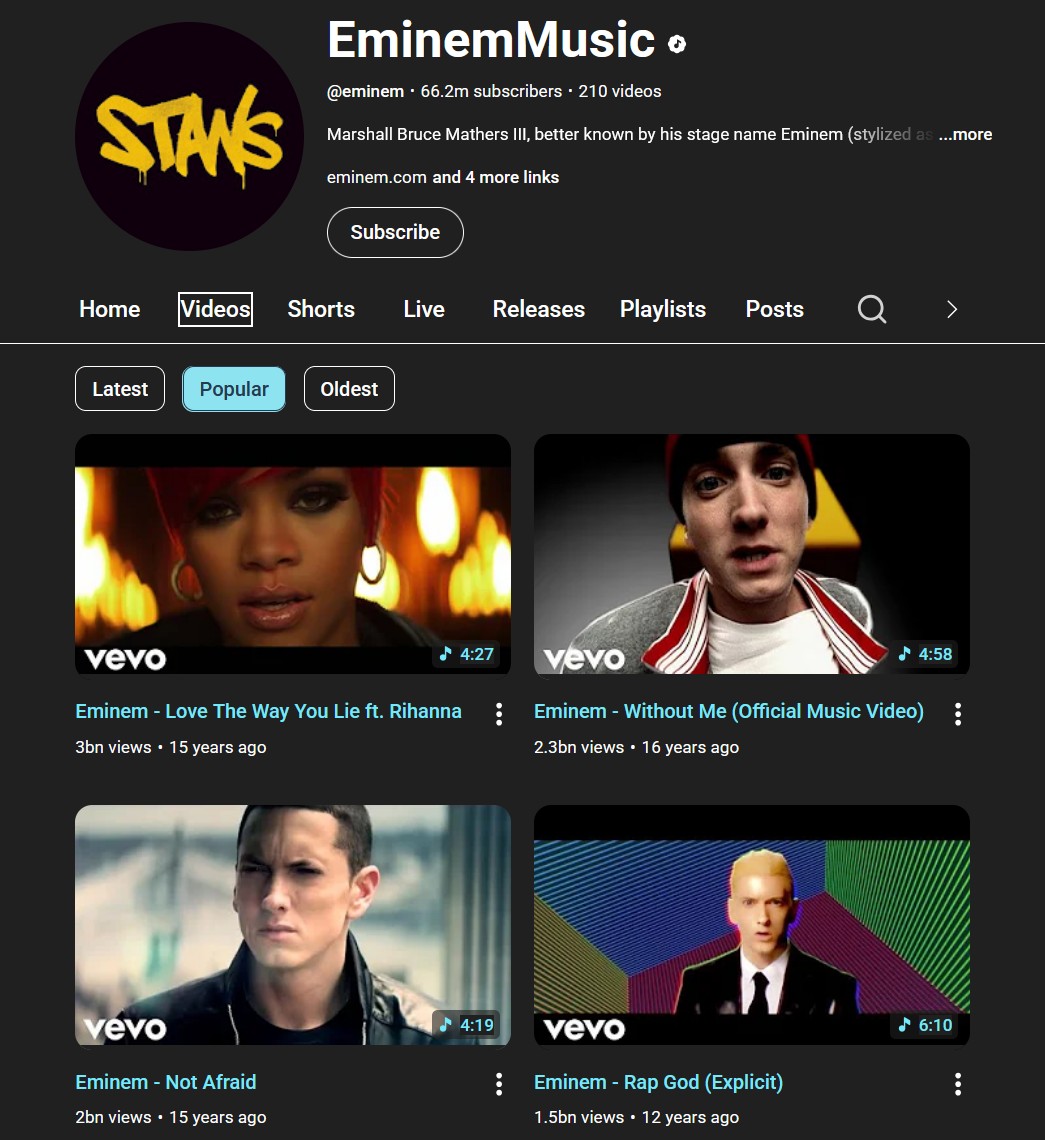
In practical terms, this means Billboard charts will reflect a narrower version of popularity. They will favour paid listeners over casual ones, and audio-first behaviour over visual engagement. For an artist like Eminem, whose audience spans generations and platforms, that change does not erase his reach. Still, it does remove a significant portion of how it has traditionally been measured.
Whether Billboard charts become “cleaner” or simply less representative is now the open question. Evidently, when YouTube leaves the equation, the charts no longer show the full picture. Artists with massive visual audiences, including Eminem, will feel the difference.