


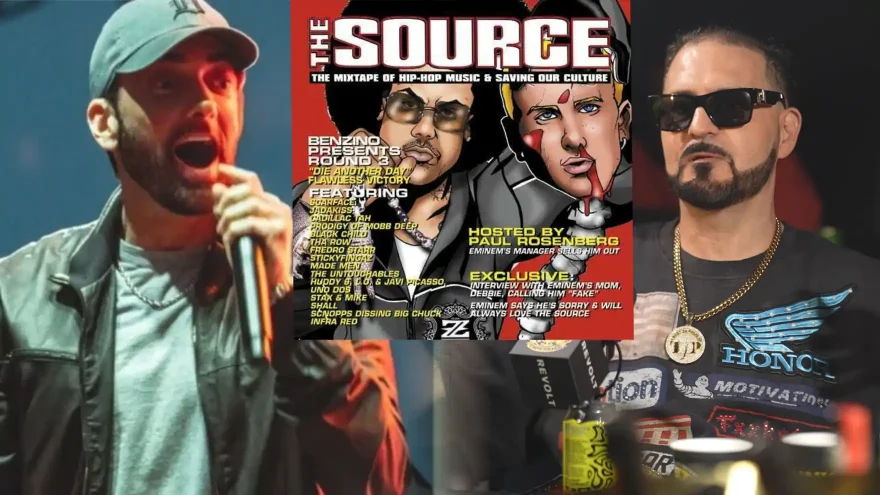
Dave Mays used to run the most influential hip hop media in the world. Then Benzino’s beef with Eminem sent the magazine into a downward spiral, in a story that still fascinates the public today. Now, Dave discusses it with hip hop heads who remember the events firsthand.
On the recent Drink Champs episode, Dave Mays explained The Source’s history and why, in his telling, the label turned away from the magazine, ultimately blaming Eminem for the fallout. According to him, after the split with Benzino, Interscope and, more broadly, Universal Music Group turned away from The Source in favour of other publications, essentially suffocating it with what Mays describes as an information blockade. At the same time, Dave Mays insists, The Source gave Eminem his first major push. The whole panel remembered Eminem’s appearance in The Unsigned Hype. Now, Dave Mays insists their relationship grew even stronger after that.
The Source showed Eminem mad love for years from when he came out. He was the first white person ever on the cover of the Source magazine. He won a Source award for lyricist of the year out in LA very early in his career. We had a lot of respect and a lot to do with helping Eminem in the early stage of his career.
Power of interpretation
Mays’ version of the story even led one of the panellists, singer Miss Jones, to describe the situation as “betrayal”, while avoiding saying explicitly who betrayed whom. The way Dave tells the story now does little to clarify matters, as he prefers to omit several important steps that undermined the magazine’s credibility and made Eminem resent the publication that noticed him early on, even if their attention didn’t play a decisive role in his success. The fact that Benzino gave his own albums five-mic reviews while downgrading others, triggering mass resignations from the editorial staff, is completely absent from Mays’ retelling.
The whole situation started from Benzino mentioning Eminem on the mixtape, Eminem going crazy, started putting out these diss records. It came from there. Then it kind of escalated when the tape showed up. There were a bunch of songs that were brought to us that we were going to publish. Then they sued us, and it became a bigger situation. When those tapes came, and they were like, “Hey, we don’t want you to put them out. We want to give you a deal”. In the end, it was decided that we had a journalistic obligation to talk about this music that was discovered.
The escalation
One of the panellists exclaims out of sight: “What a bad idea!” Time has proved that it was indeed not a smart move. And while calling the publication of counterfeit CDs containing unreleased material from one of the hottest artists of the time a journalistic duty sounds grand., it’s not entirely convincing. At least it didn’t convince the judge, who stopped The Source from distributing a CD with its February 2003 issue. Benzino, then a co-owner and editor of the magazine, planned extensive coverage of “Foolish Pride”, a song Eminem recorded in his teens, later regretted and never planned to release, and for which he apologised profusely after The Source dragged it into the public eye. In terms of journalistic integrity in this particular case, Benzino went above and beyond. He informed everyone. The initial court decision was overruled, and a judge allowed the magazine to publish limited excerpts from the lyrics and to distribute CDs containing small clips of the songs. But it was not enough.
In November 2003, the Source held a press conference accusing Eminem of racism. The magazine published a poster of Benzino holding Eminem’s severed head. Then Benzino violated the court decision by publishing the full lyrics on the magazine’s website. The Source even filed a countersuit against Shady Records and Eminem, claiming it held the rights to the songs. It was reckless behaviour, and Interscope withdrew its advertising from The Source. Others followed. Ad revenue for that scandalous February issue of The Source dropped 40%.
The Elvis argument
Still, David Mays himself insisted that the magazine’s crusade against Eminem was way bigger than Benzino’s personal vendetta. “We’re the only ones that understood hip-hop”, proclaimed Mays in the article. To this day, Mays appears unwilling to acknowledge how Benzino’s feud damaged the magazine he helped build. He keeps repeating the same comparison, painting Eminem as hip hop Elvis.
Meanwhile, Mecc Rashawn, a hip hop journalist and music executive who watched the drama unfold in real time, had to remind the room why this analogy does not work:
“Elvis was a product of his time back then. Everybody was swapping songs in and out, and people were stealing other people’s music, etc. Eminem wasn’t just doing what everybody was doing. There was never a time in the ’90s where if you weren’t writing your own shit you weren’t immediately escorted out the door. Em was a product of his time, too. He was freestyle battling people on camera”.
“But it’s the difference between being a thief and a phoney and somebody like Eminem. Eminem was authentic”, finishes Doggie Diamonds, the Brooklyn DJ and hip hop commentator.
But Dave Mays comes back with the same argument: Eminem is a vehicle the industry used to hijack hip hop.
Benzino’s feud with Eminem began more than 20 years ago. Yet not only Benzino, who still brings it up regularly, but Dave Mays himself seems to hold on to the same interpretation of what happened – one that did little to protect either The Source or its standing in hip hop.
In January 2004, Randy Lewis finished his article for the LA Times with quotes from Mays that seem to summarise his unmoving conviction then and now, as well as the reflection on the outcomes of the beef:
“Mays pondered the question of whether the Source’s focus on Eminem might undermine efforts to promote meaningful debate on the wider issue of who deserves to reap the rewards of hip-hop’s transformation from a street art form to an international cultural phenomenon.
‘He’s up there. He’s the tool being used by the corporations’, Mays said.
As to whether targeting Eminem will do more harm than good in the long run, ‘that’, Mays said, ‘remains to be seen’”.
Twenty years into the Benzino beef, the consequences are here for everyone to see.