

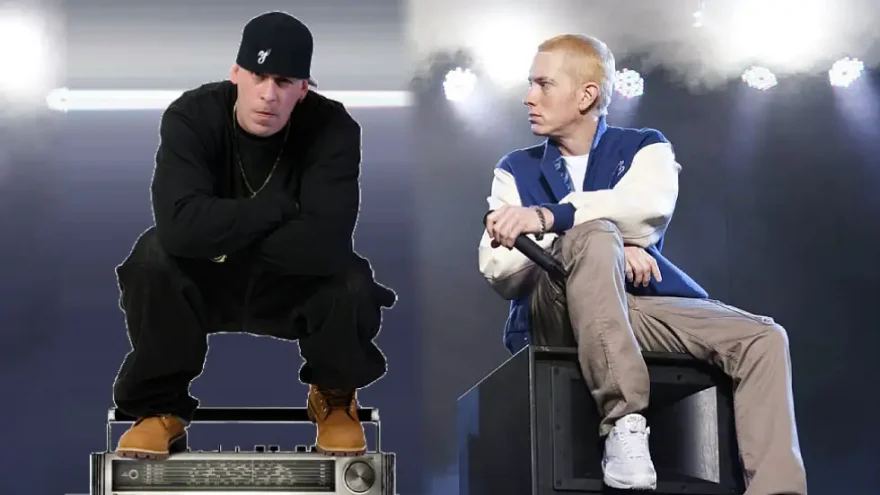
When Eminem became the hottest rapper in America, labels started treating diss records like marketing campaigns. Miilkbone now says he was part of that machine, too. His latest interview adds another chapter to the long history of artists pressured to profit from Slim Shady’s fame.
Talking to Panda Chop, 1990s rapper Miilkbone looked back at the era when record labels saw Eminem’s growing fame as an opportunity to get attention. And sometimes, they were ready to pay for it.
Fight music
For Miilkbone, it all started when Eminem came out swinging at all white rappers active in the scene at the time. Prime Minister Pete Nice, MC Serch, Miilkbone, Everlast and Vanilla Ice – Slim Shady fired shots at all of them on “Just Don’t Give a Fuck”.
I’m nicer than Pete, but I’m on a search to crush a milkbone
I’m everlastin’, I melt vanilla ice like silicone
I’m ill enough to just straight up diss you for no reason
Later, Marshall said in an interview that this track was his introduction to the underground rap world, and that he wanted to separate himself from the image white rappers had at the time. Famously, this militant attitude resulted in beefs with Everlast and Cage. But Miilkbone’s reaction did not become anything serious, maybe because he was almost a year late with his response, or rather, two.
Also, Eminem dismissed him brutally in the interview with Debbie Rigaud for Black and Gold: “I wasn’t even dissing Milkbone on my album. When I said “I’m on a Serch to crush a Milkbone”, I was talking about stereotypes, and now, I heard, he wants to bring it, so he could bring it and look stupid, you know what I’m sayin’! I heard his shit, and his shit is garbage. I wish it was dope enough for me to respond, but it’s not, you know what I’m sayin’? So fuck it. I’m not giving them any more attention”.
Beefing for cash
That was the end of the story for Eminem, but not for Miilkbone.
In 1999, he responded to Eminem’s line with a diss track, “Presenting Miilkbone”, released on the Death Row compilation Chronic 2000 Suge Knight Represents. Two years later, he included another one, “Dear Slim”, on his album U Got Miilk? Now, he says it was not the result of his personal hurt and hatred. Instead, label executives guided him towards conflict because they wanted publicity.
“When I released Eminem diss, it was the new label that pushed for it as the reason to sign me. They wanted another gimmick”, he said on Panda Chop. Em’s popularity had not yet fully crossed into the mainstream. Still, the trend was undeniable, and Miilkbone understood where things were heading. “[Eminem] became a household name in schools faster than rappers become household names in adult houses. There was really nothing to stop his progression except himself”, he recalled.
The goal was to latch onto this momentum. According to Miilkbone, people connected to Death Row Records contacted him after getting approval from Suge Knight, offering money to continue going after Eminem. “I got a call out of nowhere from Death Row”, the Jersey rapper revealed. “Suge was locked up, so somebody from Death Row contacted me. Suge was locked up, but he gave the green light that he wanted to pay me to go after Em. That was a mistake of even my second label. They were like ‘go after Em, go after Em’”.
Still, Miilkbone says radio stations and DJs already understood the imbalance. Why support a diss record against the hottest rapper in the country, especially one backed by Dr. Dre? Legendary radio host Funkmaster Flex saw through the scheme. “When we approached Flex to play Eminem diss, he wanted to charge a lot of freaking money. Flex was smart. Why would I play this record, going against Eminem when he’s hot as hell and he got Dre, and you are just a little tiny label right now, and you’re putting out a song as a Miilkbone as a gimmick going after Em?”
“Even if you won, you won’t win”
Yet, blaming everything on the label does not negate the fact that Miilkbone was angry with Slim Shady. When their paths nearly crossed, he was ready for confrontation, just not necessarily a rap battle.
“I was backstage at Sound Factory and Proof, and his whole crew was there”, Miilkbone said. “I didn’t even actually want battle, battle. I just wanted to be face to face with Eminem. He was backstage in his dressing room, and he didn’t come out”. Miilkbone and his posse went to see Funkmaster Flex, but instead of mediation received solid advice. “Flex made a good point. He said: ‘You know what? Even if you got on stage and beat him in a battle, this whole place came to see him, you won’t win. Even if you won, you won’t win’”.
Looking back now, Miilkbone admits he was too young, angry, and desperate to understand the bigger picture around Eminem’s success. Meanwhile, he says Eminem’s team handled everything professionally from the beginning. “Everything from Em’s side and everything that had to do with the whole Eminem situation was done right over there. He was guided the right way. He was raised better than I was raised, professionally, musically. That’s just a fact”.
Repeating pattern
Miilkbone’s story is not unique. Over the years, other rappers shared similar stories. However, the outcome was different because they behaved differently.
In 2021, Brooklyn battle rapper Math Hoffa admitted he once considered joining Benzino’s anti-Eminem campaign because he thought it could fast-track his career. However, he backed away after seeing how heavily the strategy relied on manufacturing controversy.
“Years ago, when I was just still a youngster, Benzino called me up to be a part of that mixtape dissing Eminem. I said yes”, Hoffa admitted. “I thought this was the way to skip the shiny suits, and everybody will know who I am!” I got to the studio. I thought he was going to fall back and let me handle it”. Instead, Benzino started playing him diss tracks aimed at Eminem, one after another. “At that point, I was like, “Yo, bro, what are you doing?” He was like, “Yo, I’m making a whole mixtape, and I’m going to drop it with The Source”. And then I was like, “Nah, this ain’t it”. ’Cause in my mind, I was like, “Em is better than you, bro”. I kinda like the way you rap, it’s a challenge, but, you know…”
Meanwhile, KXNG Crooked said he was pressured to side with Ja Rule during his own feud with Eminem. He refused. “I was like, ‘Nah, that’s not my beef. I just got over here, you know. I’m trying to make great music. I’m trying to bring that back to the W. That’s my focus, Yo, Dre is the greatest producer ever. Sounds like Em got bars and all that’”.
Years later, that decision helped build real relationships with both artists.
Looking back now, the contrast reveals two different ways of navigating the industry. Some artists chased quick attention through conflict. Others stayed away from the noise and built lasting careers instead. Chasing clout using Marshall’s name is still a popular tactic. Yet, not a single successful career came out of it.