
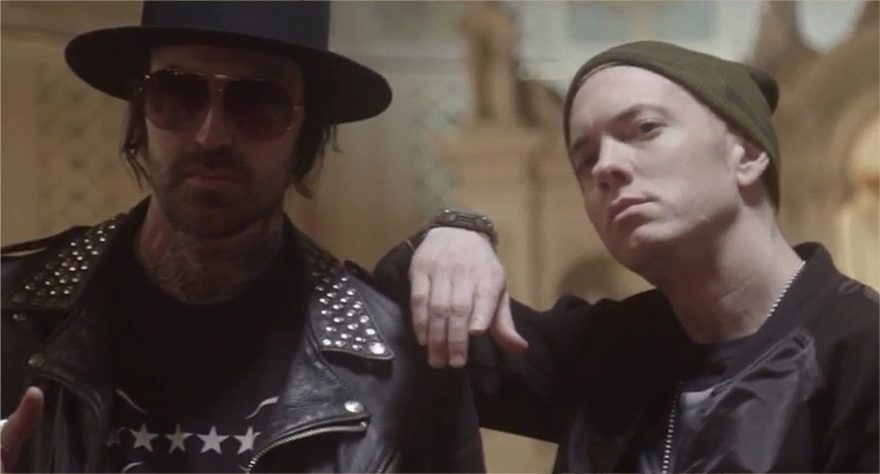
In a recent interview on the Truth Hurts podcast, Yelawolf gave one of his most open accounts of his relationship with Eminem and Shady Records – before, during and after his time with the label. And while Yelawolf believes that not all Marshall advice was sound, he still lives by some of it to this day.
Yelawolf came to the world of hip hop where there was no place for him. People around him believed Eminem’s arrival left no room for another white rapper, so Yela had to reinvent himself several times until following a suggestion from Kawan KP Prather, he recorded a stripped to the bone, aggressive mixtape Trunk Muzik. Alongside that growing success, Yela had one overarching goal: to meet Eminem:
“Pop The Trunk” kept making waves, and I was like, “Where is Eminem?” I had a tape of one of his demos that I had stolen out of the office in New York from someone who passed on him. His name was Mark Seagull, and the tape lay on the floor. I had a mission: put this tape in his hand.
Yela kept asking his executive producer to show his music to Marshall, but KP Prather did not take the request seriously. In the end, Yela’s music reached Marshall on its own merits and took Yelawolf to Interscope:
I looked at KP and said, “You played my shit for Eminem yet?” And he was like, “You’re fucking crazy, you are hopeless”. And I was like, “Man, play my shit for Eminem!” But he never did.
Eventually, Jim Jonsin ended up playing “Pop The Trunk” to Eminem while he was doing “Aeroplanes” with Hayley Williams. He actually had a homie filming Eminem watching “Pop The Trunk”. And then a couple of days later, Jimmy [Iovine] made the call: “Marshall is interested”.
Jimmy Iovine showed Yelawolf a level of respect he hadn’t seen before, offered an open check, took him to a Kobe Bryant game, and offered support and encouragement. Yela got signed to Shady Records and was eager to work on what later became his Radioactive album:
Marshall didn’t know I was making a record. As soon as we signed, we went straight to the studio.
Yela was working with Poo Bear, a versatile songwriter who collaborated with Lil Wayne, Skrillex, Travis Scott, and, notably, Justin Bieber. It was a new direction for Yela, but he was deliberately chasing an “active on radio” vibe. And eventually, the time came to show it to Eminem:
We went to LA to Marshall’s Super Bowl Lipton party ‘cause he did a Lipton commercial for the Super Bowl. Dr. Dre walked up to me and said “Hey man, huge fan”. My heart… I was like, “Amazing. Thank you, sir”. Slaughterhouse was there as well, and Marshall. It was Shady 2.0 at the table. I was like, “Marshall, I got an album”. “You got an album? When?” I was like, “I’ve been in Vegas. We knocked the album out”. He was like, “Paul, book a studio tomorrow. I gotta hear this shit”. So we went there and played it for him. And of course, he loved it. We did some work on it, obviously, in Detroit.
But even more important for Yela was that he finally completed the mission he had set himself before Shady Records was even a possibility:
I did take the tape I held onto for 10 years and put it in his hands right there. He was like, “Where the fuck did you find this?” He remembered Mark Seagull. He remembered where he recorded it. He was living in an apartment with Royce 5’9 at that time. He gave me all the backstory on the tape. I didn’t ask for a photo. It was a huge moment. Handing him that tape was more important to me than signing a deal, personally, because I made it happen.
However, the pressure of being signed to Shady Records came to bite Yelawolf, forcing him into some creative compromise. Even Eminem, Yela believes, made him put out a song that did not fit the Slumerican vision:
Everybody wanted a piece of this record because Marshall signed a white boy from Alabama. I let go of a lot of creative space. There were ideas that didn’t work. On Radioactive, there are some great records. But one song that I never wanted to be on the record was a “Good Girl”, a record written by Poo Bear. I wrote the verses, Poo Bear wrote the thing. I begged KP not to play it for Marshall. When I got to the studio, Marshall turned around in his chair and like, “Yo, that ‘Good Girl’ record though! That shit’s a hit, dude”. I looked at KP like I wanted to kill him. I was like, “If you want it to be on the record, you gotta tell everybody that you made me do it”. And that’s why he did that skit [on the outro of the “Throw It Up” collaboration]: “Bitches love love songs!”
So, he gave me the alley-oop, and of course it didn’t work. And their next pitch was to put 50 Cent on the remix. And I was like, “No way, I’m not using my 50 Cent card on ‘Good Girl’. Not happening. I don’t even love the song, why would I do that? We bumped heads, but in the best kind of way. It allowed me to do what I wanted to do on the next record, which was Love Story.
Still, Radioactive left fans disappointed. Apparently, Eminem did not smell the hit. “Good Girl” is one of the least-played songs on the album. Fifteen years after its release, it still hasn’t reached 5 million Spotify streams. Meanwhile, there is another piece of Eminem’s advice that Yelawolf respects to this day:
“You know you don’t have to do those interviews, right?” That was the best advice ‘cause I fucked up on ESPN one time. I was hungover terribly. It was early in the morning, and I didn’t want to be there, and it was one of the biggest shows on ESPN. I don’t even know what show it was, but he called me the next day like, “Hey dude, if you don’t wanna do it, just don’t. Just walk away. It’s better not to than to have a bad look”. Oh, and the other best advice he gave me was, “Turn your ‘me’ into a ‘we’ when you are writing”.
Yelawolf left Shady Records after Trunk Muzik 3 (2019). Some attributed it to disappointment with his career progress and disagreements with other members of the Shady family; others pointed out that Yelawolf crossing into the rock and country territory was not in line with the hip hop philosophy of Shady Records. Yelawolf has always maintained that he wanted more creative control and freedom, and that music was only one avenue of his creativity. That’s why he launched Slumerican, which serves as an umbrella for his fashion brand, music albums, and cinematic experiments. Each time Yelawolf talks about Eminem, there is nothing but respect, which he sees reflected in the label’s actions as well:
I have not spoken to Marshall since I left Shady. They just put out the 10th anniversary of Love Story. Shady just put it out recently. I’ll always have respect and love for Marshall. He put it out there for me. He did plenty for me. I could ask for nothing more.