



On June 18 2010, Eminem released Recovery, his seventh solo studio album, which redefined his career and the course of mainstream rap.
We all know the stats – two No.1 hits, over ten million sales, the world’s best-selling album of 2010, a Grammy win, and a certified classic. Yet there is more to this album that rarely gets discussed. Let’s have a look at some lesser-known stories behind the making of the album.
1. Eminem recorded over 100 songs for the project
The album began life as Relapse 2. Eminem eventually felt the new material sounded too different from Relapse and scrapped the sequel concept altogether, renaming the project Recovery. According to interviews from the era, Eminem went through a massive amount of material while deciding whether to make Relapse 2 or something entirely different. The final album contains 17 standard tracks, but dozens upon dozens of songs were recorded, scrapped, rewritten, or repurposed.
That’s one reason why the shift from Relapse to Recovery feels so dramatic. It wasn’t a small course correction but the result of essentially rebuilding the album from scratch.
2. The Only Solo Album Without Skits
Recovery is the only solo studio album in Eminem’s entire discography that doesn’t feature a single skit or interlude. For Eminem in 2010, it was bizarre. His every major studio album from The Slim Shady LP through Relapse contained skits, fake commercials, phone calls, or comedy bits.
Recovery was the first Eminem album to completely abandon them and just give listeners song after song.
3. The long and lonely road
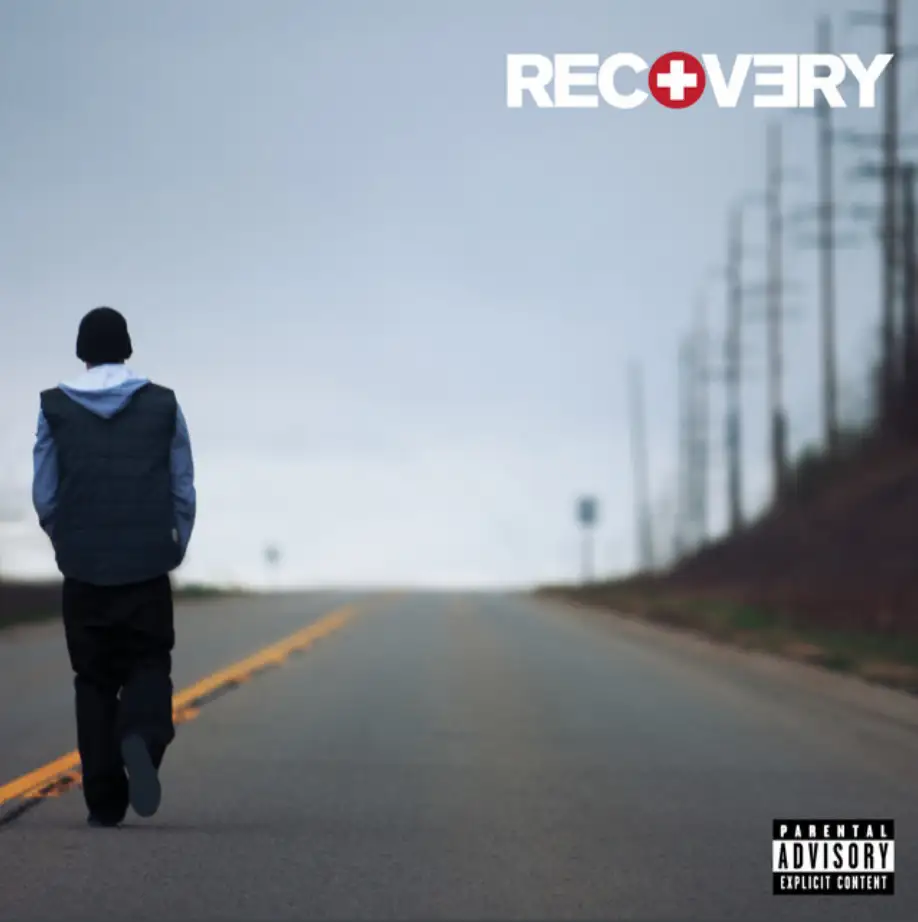
The album artwork features Eminem walking down a long, solitary gravel road. Marshall used this image as a metaphor for his isolation during the depths of his drug addiction and the long, uphill journey of getting sober. The road he’s walking on is real – Dutton Road in Auburn Hills, Michigan, not on a studio set.
4. “Not Afraid” almost had no chorus at all
Early versions of “Not Afraid” reportedly went through several structural changes because Eminem wasn’t convinced the song needed a traditional hook. The final version feels like a stadium anthem. However, at one point, it leaned much more toward a long motivational rap with minimal singing.
This transformation from hard-core rap to one of the defining pop-rap records of the 2010s mirrors the evolution of Eminem’s whole style.
5. Production shift and “No Dr. Dre” panic
For years, Eminem relied heavily on Dr. Dre and his in-house circle. On Recovery, he worked with a much broader group of producers, including Just Blaze, Boi-1da, Alex da Kid, Jim Jonsin, Havoc, amd more. It was one of the biggest sonic changes of his career.
When the leaked tracklist revealed that Dr. Dre had produced only one song (“So Bad”), fans panicked. In reality, Dre was heavily involved behind the scenes. Because Eminem was unlearning his Relapse accents, he was terrified of sounding corny. According to mix engineer Mike Strange Jr., Dre acted as a critical quality-control filter, reviewing outside beats and advising Eminem on his vocal delivery to ensure the new, aggressive tone landed correctly.
6. Eminem wanted Rihanna on a different song
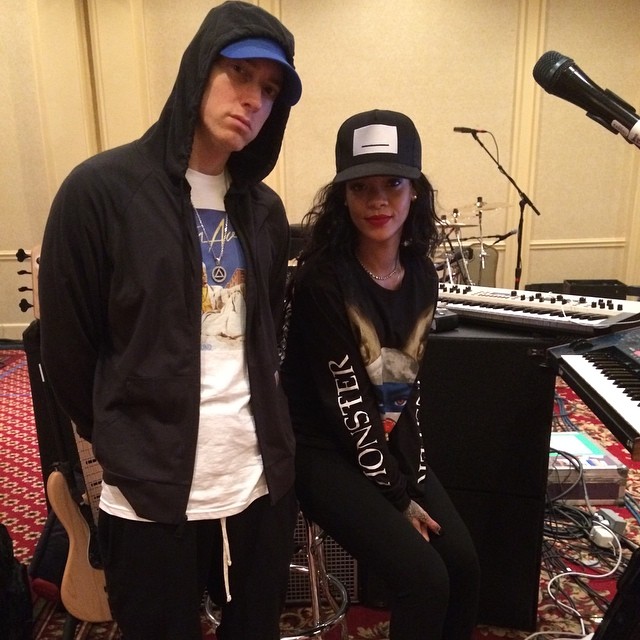
Before “Love the Way You Lie” was finalised, the track “Fly Away” (produced by Just Blaze) was heavily positioned to be a major single for the album. Studio rumours and leaked rough cuts reveal that Rihanna was originally asked to sing the hook for “Fly Away”. When that arrangement fell through, the track was completely scrapped from the album, and she was later brought in for “Love the Way You Lie” instead.
7. Redemption story
Identifying a mentality behind Recovery, Eminem chose redemption.
“There was an underlying feeling with me that I wanted to redeem myself”, Eminem said. “I felt Relapse was, I don’t know. I don’t know if people know what I really had to go through to be able to make Relapse and to be able to write again and to be able to think again and just normal everyday bodily functions and functions in my mind. I don’t want to say I wasn’t in a place to record again, but I needed time. I needed time to be able to figure out things. I wanted to be able to make my songs feel like something again. I know a lot of stuff on Relapse was comical and funny punchline jokes, but a lot of the songs didn’t really feel like anything. I had to go back and listen to some of my older music to try to figure out what I was doing wrong. Once I felt like I figured that out, I started making songs that felt like something again”.
8. Eminem did not want to use a 1990s Eurodance hit for “No Love”
This joint with Lil Wayne samples Haddaway’s “What Is Love”, using a dance-pop hit for a high-energy hip hop record. However, Eminem was initially highly sceptical of rapping over a corny 1990s dance club beat. Producer Just Blaze had to convince Eminem to use it. He chopped the sample right in front of him in the studio, beefing up the drums to demonstrate how hard the flip could hit. He made his case.
9. The “Seduction” micro-timing fix
Produced by Boi-1da, “Seduction” is highly regarded by studio engineers for its intricate vocal arrangement. It wasn’t simply a case of rapping over a beat. Eminem had the engineering team manually adjust the pocket of the instrumentals line by line. They nudged snare hits back by milliseconds in specific bars to perfectly match the syncopation of his changing cadences, creating a subtle, hypnotic “pulling” effect on the listener.
10. Digging a trench for Dr. Dre
Eminem bought Effigy Studios in Detroit in 2007, making it his primary creative bunker. When preparing Recovery, his longtime engineer, Mike Strange Jr., had to physically gut the control room because Dr. Dre was flying in with a massive entourage of producers. The room was literally too small for them. So Em’s team knocked down walls and dug a physical trench in the studio floor just to hide and manage the massive amount of heavy audio cabling required to hook up everyone’s gear simultaneously.
11. The “Won’t Back Down” cinematic guitar riff
Many people assume the song is built around a rock sample. In reality, producer DJ Khalil interpolated elements inspired by Hans Zimmer’s score, creating the cinematic feel that runs through the track. It explains why the song sounds more like an action-film trailer than a traditional rap record.
12. The scream at the start of “On Fire” is a stock sound effect
Fans spent years wondering if it came from a horror film, a skit, or a custom recording. It’s actually a library sound effect that had appeared in other media before Eminem used it. Once you hear it elsewhere, you can’t unhear it.
13. “Screaming Eminem”
Eminem never announced a new vocal style, but Recovery introduced the forceful, high-volume delivery that would dominate much of his work from 2010 to around 2017. Many fans treat it as a deliberate artistic era. Yet it emerged largely from him trying to make his voice cut through the stadium-sized production he chose at the time.
14. 2. The Multi-Layer Shouting Vocal Chain
To make Eminem’s intense, aggressive “shouting” delivery palatable without tearing listeners’ eardrums apart, Mike Strange Jr. built a meticulous analogue and digital vocal chain.
Eminem primarily sang into a Sony C800G tube microphone passing through an Avalon 737 preamp.
Then Strange ran the vocals through a highly transparent hardware Massenburg Parametric EQ to instantly surgically remove harsh, boxy frequencies generated when Em screamed into the mic. For tracks like “Not Afraid”, they used a vintage TC Electronic 2290 Dynamic Digital Delay. The delay was heavily ducked, meaning the echoing effect remained completely silent while Eminem was actively rapping, only blooming and filling the empty space the exact millisecond he paused for air.
15. The Uncredited Multi-Instrumentalist Engineer
While Recovery lists popular at the time outside producers like Just Blaze, Boi-1da, and Alex da Kid, many of those tracks arrived as flat, skeletal two-track digital files. Because Eminem wanted a fuller, stadium-rock sound, engineer Mike Strange Jr. quietly stepped out of the mixing chair and recorded live guitars, basslines, and keyboard chords directly onto the external beats. He essentially acted as an uncredited session musician, giving the programmed beats a heavy, physical, analogue presence.
16. The album’s biggest hits came from outside Eminem’s inner circle
Recovery is Eminem’s only studio album where the three biggest songs (“Not Afraid”, “Love the Way You Lie”, and “No Love”) all came from producers who had never been part of his classic Dr. Dre/Bass Brothers circle. It was arguably the biggest creative gamble of his career, and it produced the biggest-selling album of 2010.