
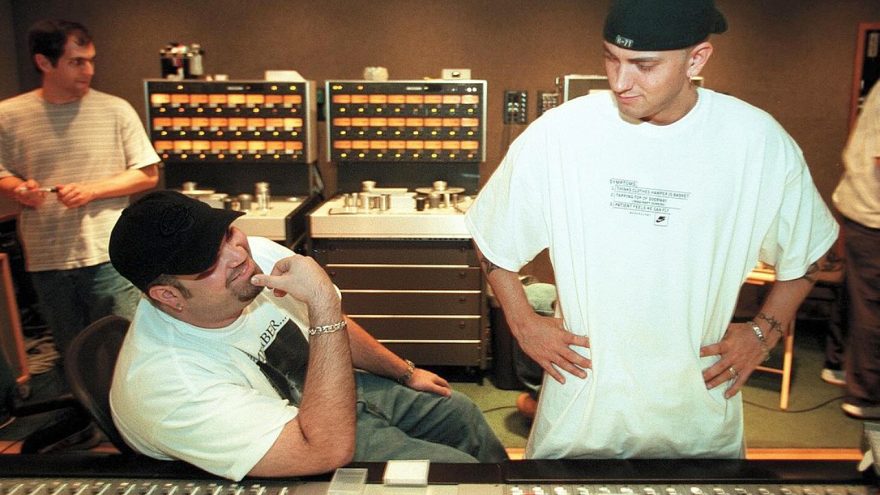
Back when Paul Rosenberg was still rapping, Proof wanted him to meet another white boy from the Detroit scene. Paul was not impressed. Years later, Paul would go on to build Em’s entire empire.
Paul Rosenberg came to the YouTube show that Tony Yayo runs together with Uncle Murda. He came prepared to the point that he brought DJ WhooKid with him, to answer the questions he wouldn’t want to answer himself, Rosenberg said, half joking.
Setting the scene
And true to his form, Rosenberg gave away very little. Two stories about meeting Eminem and about Dr Dre finding Em’s demo Paul told before, almost in the exact same words. Still, some new details slipped through this recent rendition of the lore – more about Proof’s role and a hint of Paul’s own artistic past.
Paul started by crediting Big Proof for introducing him to Marshall. “I met Eminem through Proof”, Paul starts. “When I was in law school in Detroit, I went to the University of Detroit Law School. I used to go to the Hip-Hop Shop on Saturdays. It was a Maurice Malone store, and they used to clear out all the clothing racks on Saturdays and have open mics and MC battles. And Proof was the store manager, if you can believe that. He managed the store, and he also hosted the battles”.
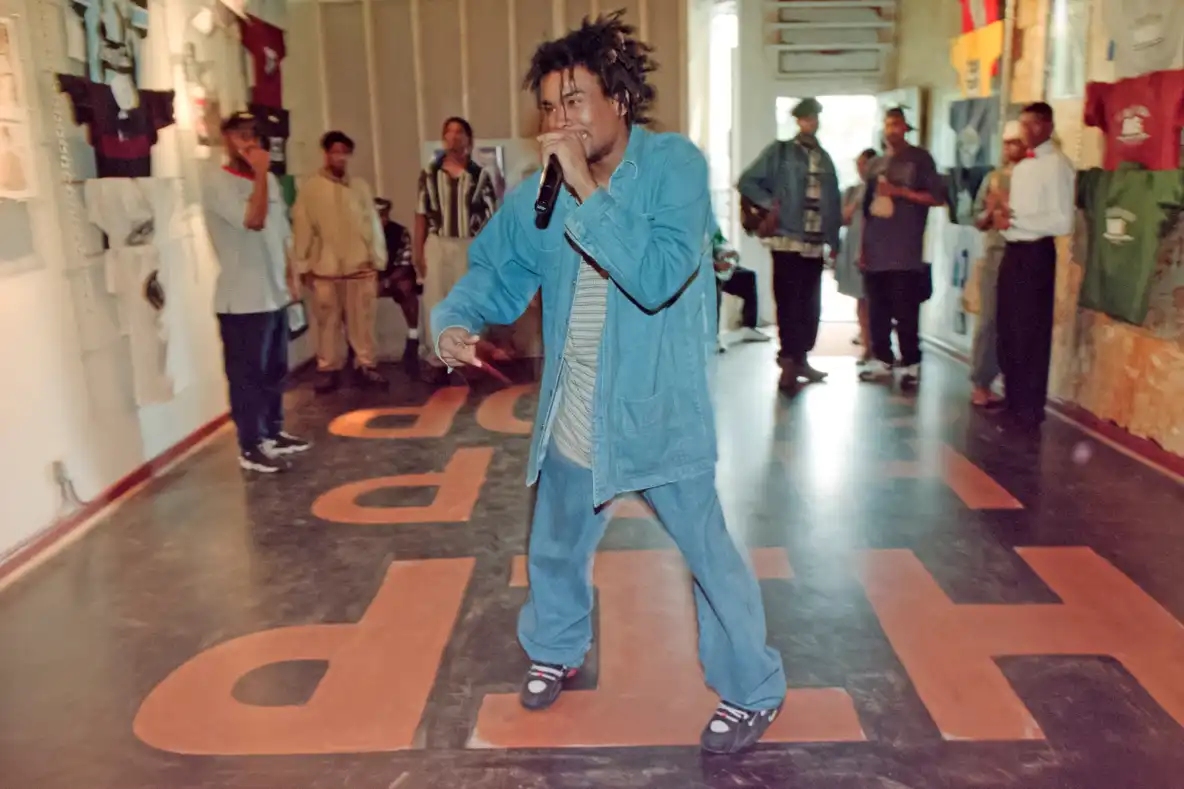
“So, one Saturday, he pulled me aside, and he said, ‘Yo, I want you to stay after. I got a kid I want you to meet. I want you to hear him rap. And I was like, ‘All right, cool. Whatever’. And he was like, ‘He’s a white boy’”.
First impression
However, it was not just an assumption that all white people who were into hip hop had to know each other. Paul was not just an observer; he was an active participant in the scene. “You probably don’t know this, but I used to rap. Proof knew me as a rapper, so he was giving me the business as another white rapper. I was happy to meet him. At the time, I was supposed to be the guy who was going to be the music lawyer for the hip hop artist in Detroit. So, I knew Proof, and I knew J Dilla, Slum Village and all those guys. I stayed after Proof cleared everybody out, and this kid walks in. At the time, he had a really low cut. He was wearing a white sweatsuit, kind of looked, you know, a little scrubby. Proof was like, ‘Yo, throw on an instrumental’”.
Yet this meeting was not a revelation for Paul. He admits that there was no indication that he had just met the future most successful rapper of the century. “He rapped and, you know, he was good. Heavens didn’t part, and the sun didn’t shine down”, Paul reminisces. “I thought he was good to really good. Did I think he was the best thing? No. He wasn’t there yet”.
In fact, Paul checked in with Marshall later, after he released Infinite, and still did not see a bright future for him. “I used to come back every Saturday, and one Saturday he was there again. He was selling an album on cassette, hand to hand, for six bucks. It was the Infinite album. His first album. I bought it from him for six bucks and again – good, really good. Definitely a lot of potential, but it wasn’t there yet”.
Hitting the mark
It took more time and a push from a friend until Paul finally could hear what he wanted to hear in the up-and-coming rapper – a claim to conquer the world. “I graduated from law school, moved to New York, and stayed in touch with everybody. Probably in early 1997, I was talking to someone who used to be my old DJ. That was the same DJ who was spinning the records at the Hip-hop Shop, DJ Head. Not the same DJ Head that everybody knows from LA, a different DJ Head. And he said, ‘You have to check out the new stuff that Eminem’s doing’. And I was like, ‘Great, but I don’t know how to get in touch with him’. So he passed me his number.
I called him up and said, ‘Hey, do you remember me?’ And he said, ‘Yeah, of course’. I said, ‘Can you send me the new stuff you’re working on?’ ‘Yeah, I’ll send it to you’. ‘Cool’. So, he mailed it to me. Remember, there’s no MP3s, no nothing”, Paul remembers this conversation almost word by word, it seems, maybe because of what had followed.
“So, he sends me this cassette and on it was ‘Just Don’t Give a Fuck’, ‘No One’s Iller’, a record called ‘Slim Shady’, and ‘Just the Two of Us’, the early version of it – the bare bones of what became the Slim Shady EP. Then I was like, ‘Okay, he’s got it’. Because he figured out his voice. He figured out his style. He became unique. He wasn’t trying to sound like other people at that point. He had come into his own. So, that’s the beginning of the story”.
The long game
Actually, this story bears repeating. Mostly, because it shows that success does not come overnight. What felt like a rocket launch for the millions who saw early Slim Shady’s music videos on MTV was the result of years of hard work, failures, and feeling his way in the dark. Paul Rosenberg was there at the very beginning, and he saw that nothing in Marshall’s trajectory was random, coincidental, or down to blind luck. That’s why they still work together.